
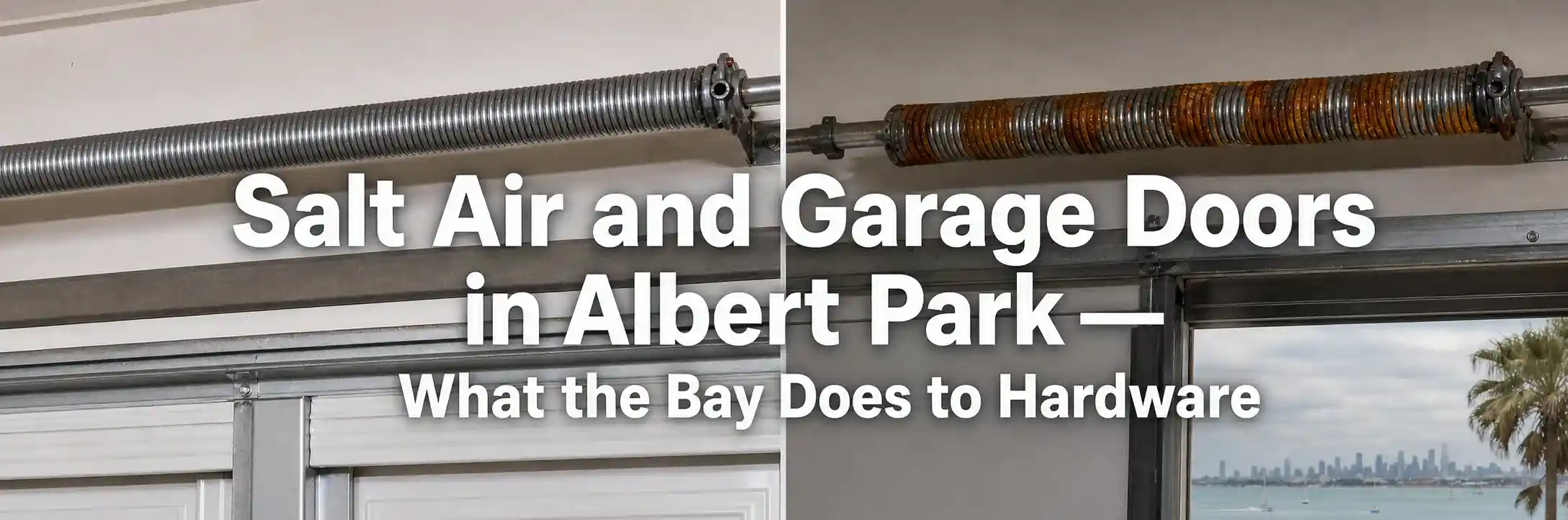
Salt air and garage doors in Albert Park is a maintenance conversation that does not apply to most Melbourne suburbs but is directly relevant to every home in this bayside suburb. Albert Park sits at the edge of Port Phillip Bay, with Beaconsfield Parade running along the foreshore and the majority of the suburb within a short walk of the water.
The salt-laden air that moves inland from Port Phillip Bay does not simply create a pleasant coastal atmosphere — it is a chemically active environment that accelerates the corrosion of metal components, promotes moisture-related deterioration of timber, and shortens the service life of garage door hardware that would last considerably longer in an inland Melbourne suburb. Salt air and garage doors in Albert Park is the conversation that protects a significant investment in bayside property from preventable deterioration.
How Port Phillip Bay salt air affects Albert Park garage doors
The mechanism by which salt air damages garage door hardware is specific and worth understanding. Salt from the bay is carried as aerosol — microscopic droplets suspended in the air — by the prevailing westerly and south-westerly winds that characterise Melbourne’s coastal weather. These aerosol droplets settle on all exposed surfaces, including the metal components of garage door systems. When the salt deposits on a metal surface and is then exposed to moisture — from rain, condensation, or Melbourne’s humid weather — a corrosion reaction begins that progressively degrades the metal.
The proximity to the bay determines the intensity of this exposure. Properties on Beaconsfield Parade and the streets immediately behind it — Richardson Street, Page Street, Danks Street — are in the highest salt air exposure zone. Properties on the western streets of Albert Park, closer to Albert Park Lake and further from the bay foreshore, receive a lower but still meaningful level of salt air exposure. For every Albert Park property, the exposure is higher than for an equivalent property in an inland Melbourne suburb.
The components most vulnerable to salt air in Albert Park garages
Salt air and garage doors in Albert Park affects different components at different rates depending on the material and its exposure position:
- Torsion and extension springs — steel springs under tension are among the most salt air-sensitive components of a garage door system. Salt air accelerates the metal fatigue that eventually causes spring failure. An Albert Park spring may fail at a lower cycle count than an equivalent spring in an inland suburb because the corrosion weakens the metal before the mechanical wear reaches the same threshold.
- Cables and drums — steel cables that lift the door are similarly vulnerable to salt air corrosion. Fraying cables that might last years in a non-coastal environment may show significant corrosion within a shorter period in Albert Park. Roller door locking bars and side guides — the steel guides that keep a roller door running straight and the locking bars that secure it are in exposed positions and frequently show corrosion signs in Albert Park garages. A locking bar that is starting to seize in its brackets is a salt air effect that becomes apparent before the mechanism fails entirely.
- Automated opener external components — the head unit of an external automated roller door opener, the drive chain or belt, and the external rail are all exposed to Albert Park’s salt air environment. Head units not rated for coastal environments develop internal corrosion on circuit boards and motor windings that causes intermittent or total failure.
The difference between foreshore and inland Albert Park exposure
Salt air and garage doors in Albert Park varies with distance from the bay foreshore, and the maintenance approach should be calibrated accordingly. The clear distinction is between the higher-exposure foreshore properties and the lower-exposure inland streets.
High exposure — foreshore and adjacent streets: Properties on Beaconsfield Parade, the streets backing directly onto the beach, and the first few residential streets inland (generally to Danks Street) receive the most concentrated salt air exposure. The bay is the primary wind source for these properties, and the marine aerosol settles on hardware with minimal dilution. For these properties, a six-monthly maintenance schedule is more appropriate than an annual one, and hardware specification should prioritise marine-grade or stainless steel components where possible.
Moderate exposure — mid-suburb streets: Properties in the central streets of Albert Park, between Danks Street and Bridport Street, receive meaningful but reduced salt air exposure. Annual maintenance is appropriate, with attention to the same component priorities as the high-exposure zone.
Lower but non-trivial exposure — Albert Park Lake area: Properties closest to Albert Park Lake and furthest from the bay foreshore still receive more salt air than inland Melbourne suburbs, because the bay exposure extends across the suburb on stronger wind days. Annual maintenance applies, with particular attention to any hardware that is in an exposed rather than sheltered position.
Specifying salt-air-resistant hardware for Albert Park
When replacing or installing hardware in an Albert Park garage, the component specification should reflect the bayside environment:
- Springs: specify galvanised or powder-coated springs rather than bare steel where available. Some suppliers offer springs with additional corrosion-resistant treatments for coastal environments.
- Cables: stainless steel cables are available for garage door systems and provide significantly better corrosion resistance than standard steel cables in a bayside environment.
- Opener head units: if replacing or installing an automated opener, select a model with an IP rating appropriate for outdoor or coastal use, or install the head unit in a sheltered position within the garage rather than on the external face.
- Locking hardware: choose stainless steel or quality brass hardware for any components in exposed positions, particularly on street or lane-facing surfaces where the salt air arrives with the least obstruction.
The Albert Park salt air maintenance routine
Salt air and garage doors in Albert Park is managed most effectively with a regular maintenance routine calibrated to the suburb’s bayside exposure:
- Every six months for high-exposure foreshore properties: wipe all external metal surfaces with a damp cloth to remove salt deposit, then apply a corrosion-inhibiting lubricant to all moving metal parts
- Annually for all Albert Park properties: inspect springs and cables for any visible rust, corrosion, or weakening; adjust spring tension if required; test and adjust the automatic opener’s force settings; check and reseal any paint or protective coating on exposed steel components
- After major storms or extended periods of onshore wind: a targeted inspection of the most exposed components — springs, cable drum, external opener components — for any accelerated corrosion that the storm conditions may have promoted
Melbourne weather events and Albert Park garage doors
Port Phillip Bay creates specific weather events that intensify the salt air exposure for Albert Park garage doors beyond what the prevailing winds alone produce. The bay’s southerly busters — sudden, strong southerly wind changes that are characteristic of Melbourne’s summer — carry concentrated salt aerosol directly onshore at high velocity, depositing salt across the suburb with a speed and concentration that is not matched by normal conditions. In the hours following a southerly buster, Albert Park garage door components that were previously protected by a dry surface layer are suddenly exposed to a fresh, concentrated salt deposit.
For Albert Park homeowners, the post-storm maintenance check is a worthwhile habit. After any significant weather event involving strong southerly winds or extended rain, a brief inspection of the most exposed garage door components — springs, cable drums, and any external opener hardware — and a wipe-down of accessible metal surfaces removes the concentrated salt deposit before the corrosion reaction has time to progress. This five-minute post-storm routine extends the life of components that would otherwise accumulate salt damage progressively through Melbourne’s active weather seasons.
The investment in maintaining garage door hardware correctly for Albert Park’s bayside environment is proportionate to the suburb’s property values. A garage door that is well-maintained and specified for the salt air environment will serve an Albert Park property reliably for years. One that is neglected or specified for an inland Melbourne environment will require more frequent repairs and earlier replacement in Albert Park’s conditions. For homeowners who have recently purchased in Albert Park, scheduling a salt air assessment as part of the property’s first-year maintenance programme is the action that establishes the correct baseline for ongoing door maintenance.
Conclusion
Salt air and garage doors in Albert Park is not an optional maintenance topic for bayside homeowners — it is a direct consequence of the suburb’s location and a practical reality for every Albert Park garage. Hardware specified for the salt air environment, a maintenance routine that matches the specific exposure level of the property, and a service provider with experience in bayside Melbourne garages are the three factors that protect Albert Park garage door investments from the corrosion that Port Phillip Bay’s environment accelerates.