
Roller door installation in Albert Park is the garage door decision that suits the suburb’s specific physical and planning context better than any alternative. Albert Park’s Victorian terrace homes and weatherboard houses are accessed via narrow right-of-way rear lanes, and the garage openings that exist behind these homes are typically compact structures added to properties that were never designed for car storage.
The roller door’s vertical travel profile, its compact head drum, and its adaptability to non-standard opening sizes make it the most practical choice for the vast majority of Albert Park garages. Roller door installation in Albert Park also navigates the suburb’s heritage overlay requirements more readily than alternative door types, making it the preferred choice of both homeowners and the City of Port Phillip’s planning assessors for right-of-way lane garages in heritage precincts.
Why roller doors suit Albert Park right-of-way garages
The right-of-way rear lane is the vehicle access configuration for most Albert Park homes. These lanes are narrow — often just wide enough for a single vehicle — and the garage door typically opens directly onto the lane surface with no driveway apron or setback. In this configuration, a door that swings outward during the opening cycle — like a traditional tilting door — or that requires a vehicle to be positioned at a precise distance for the door to clear during opening creates a practical problem that the roller door avoids entirely.
A roller door travels straight up — the slats roll vertically into a drum above the opening, and the door face moves parallel to the door opening throughout the full travel. There is no arc that extends into the lane, no minimum clearance requirement in front of the door during operation, and no risk of the door striking a vehicle, pedestrian, or cyclist in the lane as it opens. For a narrow right-of-way lane where the door is within a metre or less of passing traffic, this is not a minor convenience — it is a genuine safety and functional requirement.
Sizing considerations for Albert Park’s non-standard openings
Roller door installation in Albert Park frequently involves non-standard opening sizes that reflect the conversion history of these garages. An outbuilding that was originally a stable or storage shed converted to garage use may have an opening that is slightly narrower or lower than a standard single garage, and the door needs to be manufactured to fit rather than selected from a standard range.
The standard single-car roller door in Australia is typically between 2.1 and 2.4 metres wide and 1.98 to 2.1 metres high. Albert Park conversions sometimes have openings as narrow as 1.8 metres — wide enough for a compact or small vehicle but not standard for a roller door ordered from a catalogue.
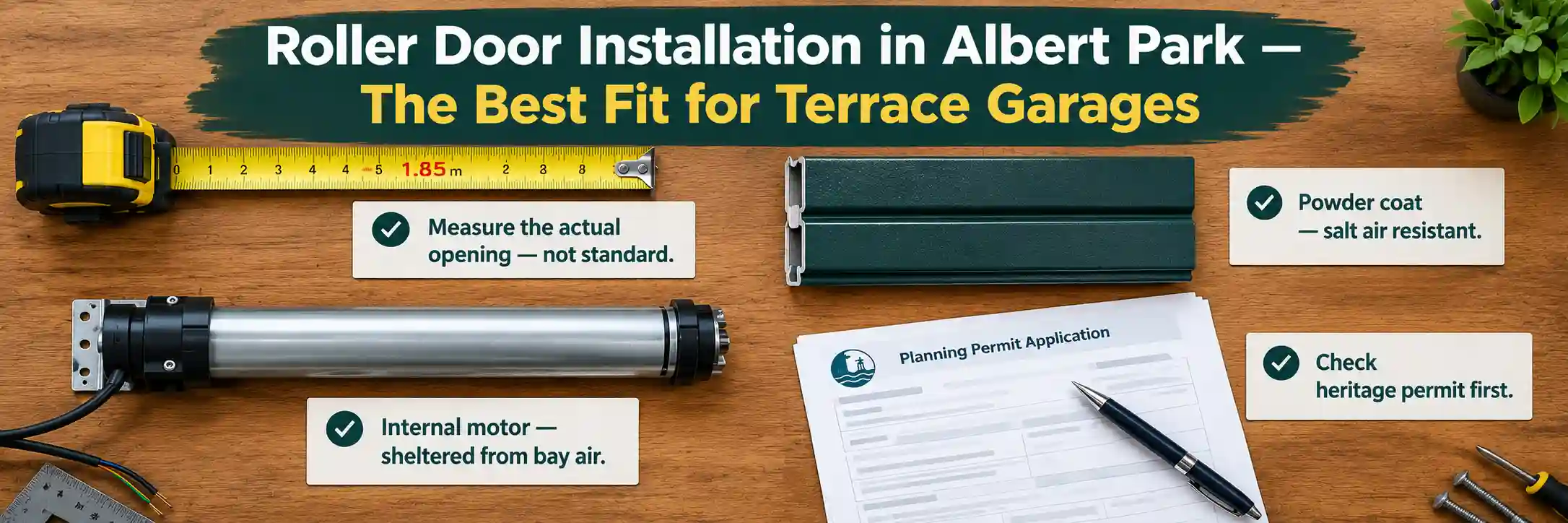
When measuring for a roller door installation in Albert Park, measure the opening width and height precisely, and measure the internal wall thickness at the top of the opening where the drum housing will sit. The drum requires a certain amount of internal space above the door opening, and a low-ceiling garage may need a low-headroom drum configuration.
Heritage overlay compatibility of roller doors in Albert Park
Roller door installation in Albert Park for right-of-way lane-facing garages on heritage properties has a significant planning advantage over alternative door types. The roller door’s profile is characterised by a flat face and a compact drum housing above the opening — a visual presentation that is relatively unobtrusive compared to a sectional panel door with its horizontal panel profile and prominent hardware.
The City of Port Phillip’s heritage planning assessors generally view roller door installations on lane-facing heritage property elevations favourably when the door is specified in a heritage-compatible colour and the drum housing is concealed by a simple fascia panel. The low-key visual presentation of a well-installed roller door in a muted heritage colour is consistent with the functional lane-facing character that Albert Park’s right-of-way lanes have historically presented. A roller door on a lane-facing elevation is very rarely the focus of a planning refusal in Albert Park, making it the lowest-risk path through the heritage overlay system for most right-of-way garage installations.
Automation options for Albert Park roller doors
Roller door installation in Albert Park for an automated system uses a tubular motor — a cylindrical motor unit that sits inside the coil drum and is invisible once the drum housing is in place. This is the preferred automation configuration for Albert Park garages for two reasons. First, the motor is internal and therefore sheltered from the direct salt air environment of the lane — an external motor mounted on an overhead rail would be more exposed to the bayside corrosion conditions.
Second, the internal motor configuration does not require a visible overhead rail that would add visual complexity to the lane-facing elevation, maintaining the heritage-compatible low-profile appearance that Port Phillip Council planning assessors prefer.
When selecting a tubular motor for an Albert Park roller door installation, confirm that the motor is rated for the specific door weight and size. Roller doors in Albert Park are sometimes wider or heavier than a standard residential door due to the non-standard opening sizes common in converted garages, and the motor must be specified for the actual door weight rather than an assumed standard.
Colour and finish selection for Albert Park roller doors
Roller door installation in Albert Park involves colour selection that reflects both the property’s heritage character and the practical requirements of the bayside environment. For heritage overlay properties, the colour should relate to the heritage palette of the property — coordinating with the fence, gate, or external wall colour in a muted tone that does not draw attention to the garage as a contemporary element.
For the bayside salt air environment, powder-coated steel roller door panels are the preferred choice over painted steel — the powder coat provides a harder, more adhesion-resistant surface that holds up better against the coastal corrosion conditions. When specifying the colour, a powder-coated finish in a standard range colour is more durable in Albert Park’s environment than a custom-painted finish, and the powder coat is available in heritage-appropriate colours across all major Australian roller door manufacturers’ standard ranges.
Getting quotes for roller door installation in Albert Park
Roller door installation in Albert Park involves a more detailed quoting process than a standard suburban installation because of the non-standard opening sizes, the right-of-way lane access requirements, and the heritage planning considerations that may apply. A thorough quote for an Albert Park roller door installation will include a site inspection rather than a phone quote — the installer needs to measure the actual opening, assess the internal space for the drum housing, inspect the condition of the existing frame and any structural repairs that might be needed, and confirm the right-of-way access for the installation vehicle.
When comparing quotes for an Albert Park roller door installation, ensure that each quote covers the same scope of work: the door panels, the drum and curtain mechanism, the motor if automation is included, all hardware for fixing the drum housing, the installation labour including any frame preparation work, and the disposal of any existing door that is being replaced. A quote that excludes frame preparation or disposal of the existing door may appear less expensive but deliver the same total cost once these items are added.
Finally, confirm with each quoting installer whether a planning permit is required for the specific installation and whether they can assist with the permit application if needed. An installer who is unfamiliar with the City of Port Phillip heritage planning requirements may not identify that a permit is needed until the installation is underway, creating a compliance issue that a heritage-experienced installer would have resolved in advance.
A well-installed roller door in Albert Park is an investment that suits the suburb’s terrace home character, satisfies the heritage planning requirements, and performs reliably in the bayside salt air environment when correctly specified and maintained. The steps of measuring precisely, specifying the right motor and drum for the opening, choosing a powder-coated heritage colour, and confirming the planning permit status before proceeding are the difference between a roller door installation that is finished and forgotten and one that generates compliance or performance issues that require revisiting.
Conclusion
Roller door installation in Albert Park is the practical, heritage-compatible, and bayside-appropriate choice for the suburb’s right-of-way lane garages. The vertical travel profile suits narrow lane access, the non-standard opening sizes common in Albert Park garages are accommodated by custom-manufactured roller door panels, the internal tubular motor keeps automation components sheltered from the salt air, and the low-profile visual presentation satisfies the City of Port Phillip’s heritage planning requirements. Specifying a powder-coated finish in a heritage-compatible colour, sizing the door precisely for the actual opening, and confirming whether a planning permit is required before proceeding are the steps that make a roller door installation in Albert Park a successful long-term outcome.