
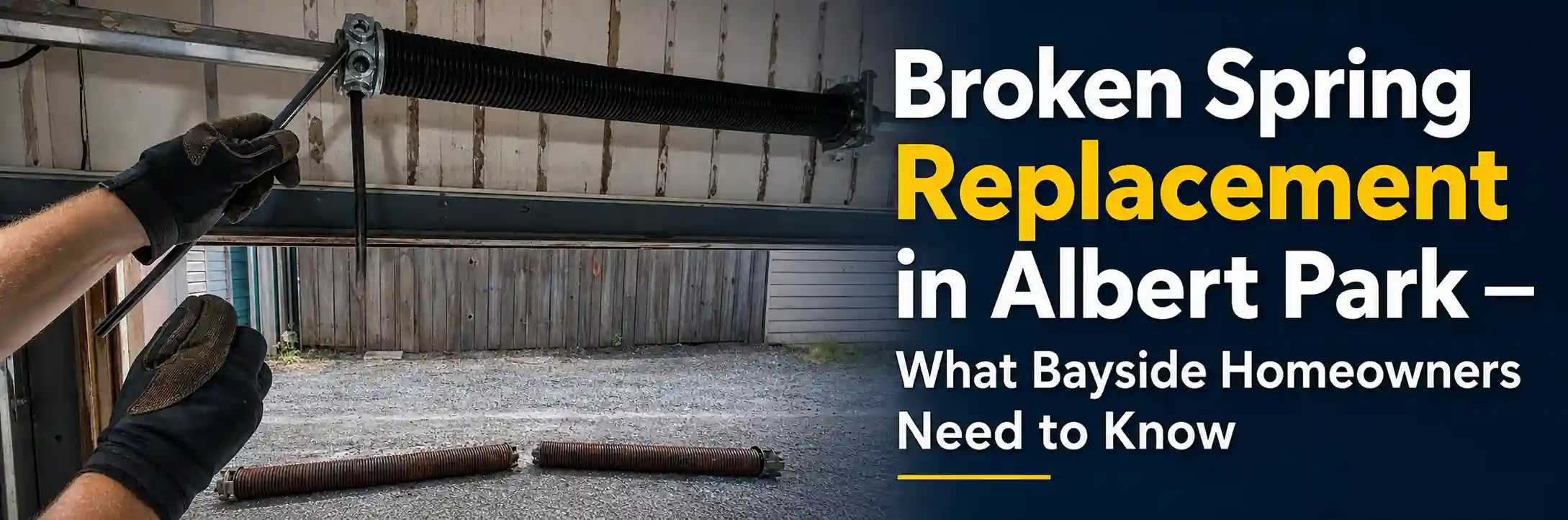
Broken spring replacement in Albert Park is an emergency repair that bayside Melbourne homeowners face more frequently than their inland counterparts. The reason is specific to Albert Park’s location: the salt air from Port Phillip Bay accelerates the metal fatigue that causes garage door springs to fail. A spring that might reach 12 to 15 years of service life in an inland Melbourne suburb may fail earlier in Albert Park if it has not been treated for the salt air environment and maintained regularly. Broken spring replacement in Albert Park addresses both the immediate emergency — getting the door operational again — and the longer-term question of how to specify replacement springs that will perform better in the bayside Melbourne environment.
Why springs fail more frequently near Port Phillip Bay
Garage door springs are under constant tension — they never fully relax, even when the door has been in the same position for extended periods. This constant tension makes the metal of the spring susceptible to fatigue over time, and the process of fatigue is accelerated by corrosion. Salt air from Port Phillip Bay creates the conditions for metal corrosion on any steel component that is exposed to the air, including garage door springs.
As the outer surface of a spring develops rust and corrosion, the effective cross-section of the metal is reduced, and the stress concentration at any surface defect increases. The spring eventually reaches a failure point earlier than its rated cycle life suggests it should.
Albert Park homeowners who have never had their springs inspected or treated for the bayside environment may be operating springs that are significantly more degraded than their age alone would suggest. A spring that looks intact but has developed surface corrosion across its coils has less structural margin than an identical spring in pristine condition. The loud bang of a spring snapping is the consequence of this hidden degradation reaching its threshold.
Recognising the signs of a failing spring in Albert Park
Broken spring replacement in Albert Park is most straightforward when the failure has already occurred — the spring has snapped and the door will not operate. But there are warning signs of a spring approaching failure that allow replacement before the dramatic and inconvenient sudden failure:
Rust or corrosion visible on the spring coils — any rust development on a torsion or extension spring is a warning sign that the spring is in a degraded condition. In Albert Park’s salt air environment, surface rust that is left untreated progresses to structural corrosion relatively quickly.
The door feels heavier than normal when manually operated — the counterbalancing force of the springs makes the door feel light to lift. When a spring is losing tension due to metal fatigue, the door begins to feel heavier in the manual operation test.
Unusual noise during operation — a spring developing fatigue may produce a creaking or grinding sound as the coils move. This is different from the sound of a door that needs lubrication — it tends to be a deeper, more structural sound.
Visible gaps or deformation in the coil pattern — occasionally a spring will show visible deformation — gaps appearing between coils, or a section of coil that looks different from the rest — before the final failure occurs.
The immediate response to a broken spring in Albert Park
When a spring fails in an Albert Park garage:
Stop operating the door — both manually and with the automatic opener. The opener motor is not designed to lift the full weight of the door without spring assistance, and running it risks burning out the motor or damaging the drive components.
If the door is stuck in the open position, assess the security situation. A right-of-way lane garage in Albert Park that is stuck open is accessible from the lane, which is a shared access way. If the garage contains valuable items or provides internal access to the home, bring valuables inside and consider a temporary security measure for the opening while waiting for the technician.
Call a garage door technician who services Albert Park and the City of Port Phillip. Right-of-way lane access in Albert Park requires a technician who is familiar with the suburb’s access arrangements — confirm that the technician knows the area before booking.
Provide the technician with as much information as possible about the door — its size and weight, whether it is a roller door or sectional door, and the type of spring system if visible. This helps the technician arrive with the correct replacement springs.
Specifying replacement springs for Albert Park
Broken spring replacement in Albert Park is the opportunity to specify replacement springs that are better suited to the bayside environment than a standard residential spring. The options include:
- Galvanised springs — a standard galvanised coating provides basic corrosion resistance and is better suited to Albert Park’s salt air environment than a bare steel spring.
- Powder-coated springs — powder coating over the spring steel provides a layer of corrosion protection that lasts longer than galvanising in an active salt air environment. Available from specialist suppliers for most standard spring sizes.
- High cycle-rated springs — standard springs are rated at 10,000 cycles. High-cycle springs rated at 20,000 or 30,000 cycles have a heavier wire gauge that provides more structural margin and is inherently more resistant to fatigue. In Albert Park, where the combination of salt air and cycling pressure accelerates spring failure, a higher cycle rating is a sound investment.
- Replace both springs simultaneously — if the door has two springs and only one has broken, replacing both in the same visit is strongly recommended. The second spring has the same exposure history as the failed one and will typically fail within a similar timeframe.
After the spring replacement — what Albert Park homeowners should do next
Broken spring replacement in Albert Park is completed — the new spring is installed, tensioned correctly, and the door is tested. The immediate problem is resolved. The follow-up actions that reduce the risk of a repeat failure within a shorter timeframe are worth implementing while the service technician is still on-site and the garage door system is fully accessible.
First, ask the technician to inspect the other springs, cables, and cable drums at the same time as the replacement.
If the failed spring has shown signs of salt air corrosion, the other springs and cables in the system have been in the same environment for the same period. A technician who inspects all spring and cable components at the same visit can identify any that are showing early corrosion or fatigue signs and flag them for attention before they fail unexpectedly.
Second, ask about a protective treatment for the new spring and any other metal components that are in exposed positions in the Albert Park bayside environment. Some technicians carry a corrosion-inhibiting spray that can be applied to springs and cables after installation to slow the surface corrosion process. In Albert Park’s environment, this treatment adds meaningful protection between service visits.
Third, book the next service visit before leaving. For an Albert Park property in a high salt air exposure zone, a six-monthly inspection and lubrication schedule is the appropriate maintenance cadence after a spring replacement. Booking the next visit immediately, while the garage door and its condition are fresh in mind, is more reliable than relying on a calendar reminder set in the future.
Broken spring replacement in Albert Park is never a pleasant surprise, but it is a manageable one when the technician is experienced, the replacement springs are specified correctly for the bayside environment, and the follow-up maintenance plan is in place. The bayside Melbourne suburb that is Albert Park creates specific conditions for garage door springs — the combination of salt air, Melbourne’s variable weather, and the regular use that comes with inner-city living means that spring maintenance and timely replacement are part of owning a garage in this suburb.
Conclusion
Broken spring replacement in Albert Park is a more frequent event than in inland Melbourne suburbs because Port Phillip Bay’s salt air environment accelerates the metal fatigue that causes spring failure. The appropriate response is immediate stop-use, a call to a technician familiar with Albert Park’s right-of-way lane access, and a replacement specification that uses corrosion-resistant springs — galvanised, powder-coated, or high-cycle rated — that are better suited to the bayside Melbourne environment than standard bare steel springs.